Showing posts with label New Construction. Show all posts

Wednesday, May 26, 2010

Design Criteria…. “This isn’t how it is normally done”…

… EXACTLY!!!!!!!!

This morning I was reading and commenting on the blog “Greige” in regards to some photos she had posted on “Bedroom or bath??  She has posted some interesting images of bedrooms that have an open bathing area within the space. 


Image via Greige


It brought to mind a couple of instances that I had encountered many years ago while studying design.  In one of my classes we were given an assignment to design a bedroom with its own bath.  The design I came up with was based on the bedroom being either a guest or secondary bedroom.  I designed the space where the tub and vanity was in an open alcove area of the bedroom, and the toilet was in a private water closet.  My teacher was uncomfortable with the idea of the open bathing area… saying that it was “not practical”.


In another class (and a different teacher), our assignment was the space planning of a kitchen.  The plan was carried all the way through final development with the designing of the cabinetry.  I chose to design my base cabinets with a plinth base… to make them look more like pieces of furniture… rather than the typical 3” toe kick.  Again… I was told by the teacher that this was “not practical”.

   
Perfect example of lower cabinets with a plinth base… I guess my thinking wasn’t so “off base”

 (can someone please tell me the source and credit for this photo?)


My thoughts were… are we studying practicalities or exploring design and its possibilities? 

I guess I have never fallen into the camp of the “go with the flow” or “status quo”.   I believe that if a client hires me for a project, it is incumbent upon me to create something that is not the typical or norm.  This is true for any client, but to an even greater extent when the project involves new construction and/or custom work.  The beauty of custom design is the ability to manipulate the elements into something unique… or something other than the norm.

This is an ongoing challenge because, until you can get through to people what a particular design concept is, you are faced with people having a preconceived idea of how something should be.  


From the previous post “Diary of a Project” , a new project that I am working on and have begun a discussion about... I was out at the project site to discuss framing issues with the client.  The client’s Realtor, who had sold them the property, was also there so that she could see the progress of the project. 

I was discussing window placement so the framers could finish up some of the framing.  In the master bath, the original architect’s drawing indicated a built-in tub in the bathing alcove.  I had made changes, indicating a free standing tub with a steel framed window behind it, to go almost to the floor.  The question from the client was... “Is it OK for the tub to be seen from the outside and the window to be so low?”  She had not seen this before.  The Realtor chimed in “Oh no, this is not normal”… indicating that this would not be a very smart idea!   

 My reply… “You’re right!  It isn’t the norm… but this is a custom home!   I wasn’t designing with the typical in mind.  When you are building a new home on over 130 acres of land… you probably won’t need to worry about someone invading your privacy.  Not to mention, that you will probably be skinny dipping in your pool, which affords even less privacy.  Besides... we can do an interesting window treatment so that privacy can be maintained as needed.”

A couple of days later when the husband weighed in on the issue, he stated he did not want a free standing tub and was going to go out to show the contractor how high to set the window.  I certainly respect my client’s choices… as this is their home and not mine.   It is my job to filter ideas to create what they want.  But as a designer it is my responsibility to show them their options and ideas that they may not have considered.  Therefore… I emailed the clients a sketch of what my design concept was in order to back up my design selection, before any decision was set in stone.

As I explained… what I wanted to create was a focal point with the tub… and makes it look almost like a piece of sculpture.  The layout of the alcove at the end of the corridor from the bedroom created the opportunity for this design.
 

Free Standing Tub as a Focal Point from the end of the Corridor


Much to the surprise and delight of the wife, her husband liked the design and was on board with the concept. 

There is a line between pushing a design on a client, and presenting ideas and options… and to me designing is all about the options.

What are your thoughts on a designer’s role in presenting ideas to a client?


Friday, April 9, 2010

Diary of a Project...

From the Ground Up


I recently took on a new project that I am very enthusiastic about. Without going into personal information or betraying client confidentiality, I would love to share some of the process and the progress with my blogging friends and readers.


This is a new construction project for a couple that is relocating from Houston to the country onto 130 gorgeous wooded acres. For the past year they have been clearing and preparing the property with a beautiful large six stall horse barn, water features, gazebos and more. Just prior to pouring the foundation I joined their team… in the nick of time. The original architect prepared a botched set of incomplete plans, so I was able to make some adjustments prior to the pouring. Since we are basically working with just a floor plan, I am able to make further adjustments, addressing problem areas throughout the floor plan in regards to space planning.


This is truly a project from the ground up…


The house is 5200 square feet single story. We are in the framing stage right now, and because some of my design concepts vary from the original plans (or lack of plans), we are able to make changes to some of the interior framing of walls and ceilings. I am thrilled to say that we have another architect working with the team that has made my job much easier! I don’t do CAD work, and rather than spend hours at my drafting table, I am able to pass the design concepts along to the architect to work out the engineering and draft the CAD drawings showing everything dimensioned.


That doesn’t get me out of all the drafting however…to date I have been working on the partition plan, preliminary furniture plan, and the RCP (reflected ceiling plan). It is of utmost importance to have a furniture plan to determine spatial requirements… not only for furniture but for traffic flow and to determine how the spaces relate to other spaces. So, all the while that I am working on a two dimensional plan, I am also thinking three dimensionally. This includes accumulating ideas for the ceiling, floors, and wall treatments… doors, windows, custom cabinetry, mill-work, lighting… on and on. To make sense of it all (and to have something visual to show the client) I bring the plans into elevations.


Elevation sketch indicating changes in ceiling heights


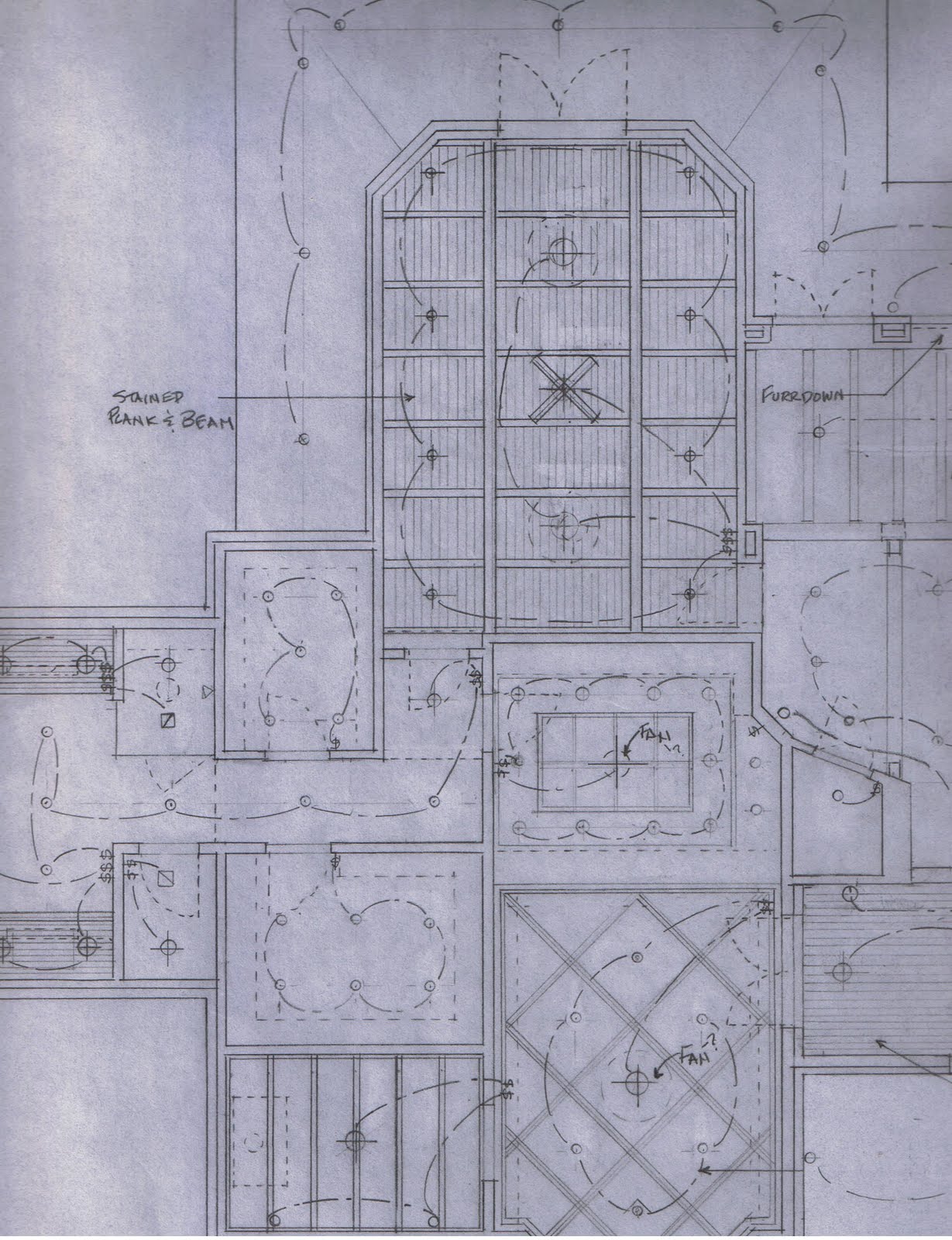
The RCP is the plan that illustrates the designs for the ceiling treatments… exposed beams, materials and the lighting… fixtures, recessed, etc. This is extremely important, because you must take into consideration not only what is on the ceiling and how your lighting will be installed in relation to beams, moldings etc., but also, all that lies below the ceiling level and the effect the lighting has on all surfaces. For instance, if you are planning a gallery wall, the type of lighting and the placement are critical to properly lighting the artwork…. the same for work spaces. Allowing for a mix of task, ambient and accent lighting is also critical to the overall effects and effectiveness of the final lighting plan. There is a lot to take into consideration!!!!


A Portion of the RCP rough draft


Currently the architect is working on the framing plan for the ceiling in the family room. I had requested that we have enough support so that we can eliminate some of the vertical posting that would interfere with the window and French door placement. The concept for this ceiling is to have a rustic plank and beamed ceiling without the use of trusses. It appears that this is proving to be difficult to engineer without some sort of truss support for this particular project… so what I have proposed is the use of collar ties in lieu of the trusses. Basically you get the same support, but they are closer to the ceiling and less obtrusive.


Here are a couple of examples of collar ties being used that are not only functional but add a great deal of architectural interest to these ceilings…


Here is an example of a plank and beamed ceiling without the use of trusses or collar ties…


A final decision on how to handle this issue has not yet been made...


My plan is to take you along as we progress… through the design and selection processes. You will see how my ideas and material selections come together to create the design concept. You will see how things not only evolve as planned, but how things can unexpectedly change… depending on the challenges, obstacles and opinions that are all involved. Even though every designer has their own style and methods of working, much of the process is the same and I think you will find the journey interesting and hope you join me as we create a new home... from the ground up.